On this page
- What exactly does the account say about working without plans?
- What do published reports say about building from memory?
- What can official sources and the press actually confirm?
- Which hull does the no-blueprint story describe?
- If the design sits in builders' memories, how does it pass on?
- Where do drawings and outside designers come in today?
- What does this mean if you commission a boat?
- How can you check the story for yourself?
- What are the short answers on pinisi building methods?
- Which sources support this page?
- How do I reach the desk?
By Pinisi Boat Editorial Desk
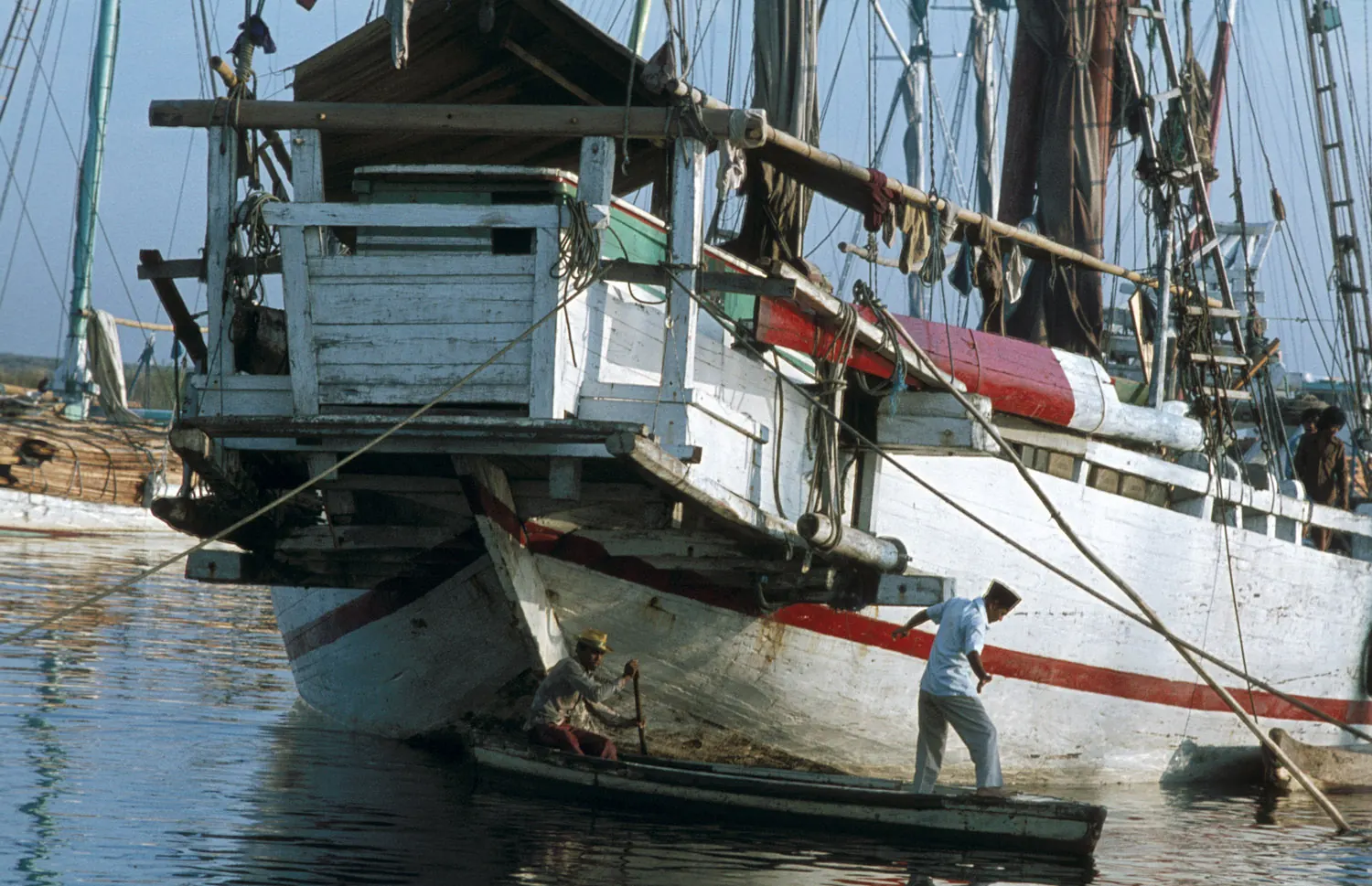
Traditional pinisi hulls are built without blueprints, according to AramcoWorld and a maritime researcher writing on SeaTrek's site: designs sit in shipwrights' heads, and a naval architect describes planks set by eye before the frames. Drawings do enter modern yacht projects, where designers may loft a hull and make mould frames. UNESCO's element page does not mention the detail.
What exactly does the account say about working without plans?
The account has four parts. The reports below back the first three, and we cannot confirm the fourth. Each is still a claim to test on site, so the table pairs it with what a visitor or client could ask to see.
| What the account says | What to ask to see |
|---|---|
| No formal blueprint for the traditional hull | Any drawing, model, template or written measurement in use on the current build |
| Shell-first order: planks fitted before frames | A hull in progress, ideally at the stage when planking is up and framing has begun |
| Wooden dowels (pasak) joining planks, not metal nails | The plank edges before closing, and a straight answer on any metal fastenings used |
| A master builder (panrita lopi or punggawa) directing workers known as sawi; we cannot confirm these titles | Who makes hull-shape decisions on this project, and how instructions reach the crew |
Some versions also give local names for ritual stages around keel laying and launching, and we cannot confirm those names. Our boatbuilding page covers the rites a published report describes.
What do published reports say about building from memory?
AramcoWorld states it flatly in a 2021 report from Tana Beru: no blueprints exist for pinisi, and the designs are in the shipwrights' heads. A researcher writing on SeaTrek's site agrees that these vessels were never built to plans. Kasten Marine Design describes hulls shaped by eye, without mould frames.
The most specific test comes from AramcoWorld. The naval architect designing a 36-metre yacht tabulated the measurements the Sulawesi builders used and, by his account, found them within a centimetre of German Lloyd's specifications for wooden vessels. That is one designer's report on one project, not a survey of the fleet, and his firm's note on cargo hulls reports many built with short planks of lesser wood, so proportion and material are separate questions.
What can official sources and the press actually confirm?
UNESCO and the yacht press cover the craft and its places, without the blueprint detail:
- UNESCO inscribed “Pinisi, art of boatbuilding in South Sulawesi” on its Representative List of the Intangible Cultural Heritage of Humanity in 2017, and describes the craft as part of a millennia-long Austronesian boatbuilding and navigation tradition.
- The UNESCO decision names Tana Beru, Bira and Batu Licin as contemporary boatbuilding centres.
- Wikipedia's entry says pinisi-rigged ships were mainly built by Konjo-speaking people of Ara, and by people of Bira, Lemo-Lemo and Tana Beru, and that the first Sulawesi pinisi is thought to date to 1906.
- CharterWorld reports that Lamima, a 65.2-metre vessel, was built on the beach at Bira and Ara by local builders.
None of them tells you whether a particular hull on a particular beach had a drawing behind it.
Which hull does the no-blueprint story describe?
Here the vocabulary needs care. UNESCO explains that pinisi refers to the rig and sail of the Sulawesi schooner, while the blueprint story concerns the hull beneath it. Those are separate things, and a phrase that joins them hides the question of which hull type is meant.
Three general hull types carry the rig, according to Wikipedia. The palari is the older form, with a curved stern and keel, raised from a pajala hull, and with twin quarter rudders. The lambo is favoured by motorised vessels. The jonggolang dates from the mid-twentieth century and is built high from the start. A method suited to one may not transfer untouched to another, so ask which form a builder has in mind. Our page on palari, lambo and jonggolang hulls compares them.
The word itself has also spread, so a modern charter vessel sold as a phinisi may share little with the cargo schooners behind this reputation.
If the design sits in builders' memories, how does it pass on?
By working beside them. UNESCO says the knowledge passes down within families and, through the division of labour, to people outside them. A drawing can be archived and handed to the next shipwright, and judgement held in one head cannot.
A summary of a UNESCO periodic report, noted with its limits on our UNESCO page, lists fewer young people entering the labour-intensive craft, rising costs, scarce quality timber and pressure from modernisation and commercialisation as threats to the tradition. If hull geometry is carried by memory, the first of those threats matters more than it would in a trade that works from paper.
For a client, the same logic applies at the scale of one project. If a boat's shape depends on one person's judgement, ask what happens should that person leave midway, and who else on the crew has seen a hull of that size through. Ask too whether anyone records the finished lines, since a later repair team will want them.
Where do drawings and outside designers come in today?
Drawings enter at least one recorded yacht project, and here the sources do not quite agree. AramcoWorld's caption calls the 36-metre Silolona crafted without formal blueprints. Kasten Marine Design says it lofted that hull's body view and built mould frames to guide the shape, in Kalimantan. So a yacht described as drawing-free had a designer's frames behind it.
Motorisation of Indonesia's traditional trading fleet came in the 1970s and 1980s, and average cargo capacity rose to about 300 tons. A pinisi-rigged motor vessel completed in Bulukumba in 2011 measured 50 metres long and 9 metres wide, with a capacity of about 500 tons, by the same source. Engines, shafts, tanks and wiring all have to fit in a hull like that.
Lamima shows a mixed model. CharterWorld credits local builders on the beach and, separately, a named exterior designer, along with an ironwood hull, an 11.20-metre beam and 1,277 square metres of North Sails. Boat International also records a design credit and a 2015 delivery. So a design role can sit alongside beach builders, although neither report says what drawings were produced or who used them.
We have no sourced account of how yards today divide drawn and undrawn work on engines, systems and interiors. Ask each builder directly, and expect the answer to differ between the hull and the fit-out.
What does this mean if you commission a boat?
You should not treat the absence of drawings as a charming detail. It moves risk onto your brief and your contract, because a shape that exists nowhere on paper is hard to dispute later. Ask for the following before any money moves:
- A written brief with length, beam, intended use and cabin count
- A statement of which parts of the vessel will be drawn, and by whom
- A scale model or mock-up if no hull drawing will exist
- Named stages at which you or your surveyor inspect, and what stops work
- Written timber and fastening specifications
- As-built records of hull lines, tanks, wiring and machinery at handover
- Any drawings a surveyor, class society or flag authority will require
The last item deserves an early question. A general summary of ministry rules mentions class and safety certificates among the documents foreign vessels may need for permitted activities, and a surveyor may want plans whatever the builder's habit.
A request through the desk can lead to a construction contract with PT Komodo Galangan Nusantara, so hold our offer to this same list. It states the work location, any fee and the payment terms. Our commissioning guide goes through the process further.
How can you check the story for yourself?
Go and look. Bonto Bahari district in Bulukumba regency contains Ara and Bira along with Tanah Beru, and the airport at Makassar is Sultan Hasanuddin International (UPG). Our guide to visiting the Tana Beru boatyards covers what to expect there. Ask to watch work on a hull in progress, and ask the people doing it the questions in the first table.
What are the short answers on pinisi building methods?
Are pinisi boats really built without blueprints?
Traditionally, yes, according to AramcoWorld and a researcher writing on SeaTrek's site. Modern yachts may differ: one 36-metre yacht had mould frames from its designer, so ask what is drawn on your own build.
What does shell-first mean?
It means the hull planks are fitted edge to edge first and the internal frames are added to the shell afterwards. Kasten Marine Design describes this order for pinisi, with the planks joined by wooden dowels called passak.
Who is the panrita lopi?
We cannot confirm these titles from a source we can cite. Accounts that use them describe a master builder and his workers, so ask whoever offers the work what titles they use.
Did UNESCO recognise building without blueprints?
Not in the text we can cite. UNESCO inscribed the art of boatbuilding in South Sulawesi in 2017, and its element page does not mention blueprints.
Should I accept a new-build contract with no drawings?
Only with care. If no hull drawing will exist, ask for a written brief, a model or mock-up, inspection stages and as-built records, and find out early what a surveyor or flag authority will require.
Which sources support this page?
- UNESCO: Pinisi, art of boatbuilding in South Sulawesi, checked Oct and Nov 2026
- UNESCO: Decision 12.COM 11.B.13, checked Oct 2026
- UNESCO: 12.COM decisions document, checked Oct 2026
- UNESCO: periodic report on the element, checked Oct 2026
- Wikipedia: Pinisi, checked Oct 2026
- CharterWorld: Lamima report, checked Oct 2026
- Boat International: Lamima profile, checked Oct 2026
- Wikipedia (Indonesian): Kabupaten Bulukumba, checked Oct 2026
- Wikipedia: Sultan Hasanuddin International Airport, checked Oct 2026
- AramcoWorld: Pinisi Boats Sail into the Future (February 2021)
- Kasten Marine Design: The Indonesian Pinisi
- Kasten Marine Design: Indonesian cargo pinisi as a yacht
- SeaTrek Sailing Adventures: Pinisi and the art of boatbuilding in Sulawesi
How do I reach the desk?
If a builder's answer does not match a source on this page, or you want to request an offer, tell the desk on WhatsApp 6281139414563 or at bd@juaraholding.com.
Send the desk what you need: build, buy, or charter, plus rough size and timing.
Ask the desk on WhatsApp bd@juaraholding.com