On this page
- Why is the answer seven or eight, and not simply seven?
- How are the sails arranged on the two masts?
- What is each sail called?
- What do standing gaffs change about how the rig looks and works?
- Why do charter brochures say seven?
- How many sails does a modern charter phinisi actually set?
- Where can you see the full rig?
- FAQ: what are the short answers on pinisi sails?
- Which sources support this page?
- How do I reach the desk?
By Pinisi Boat Editorial Desk
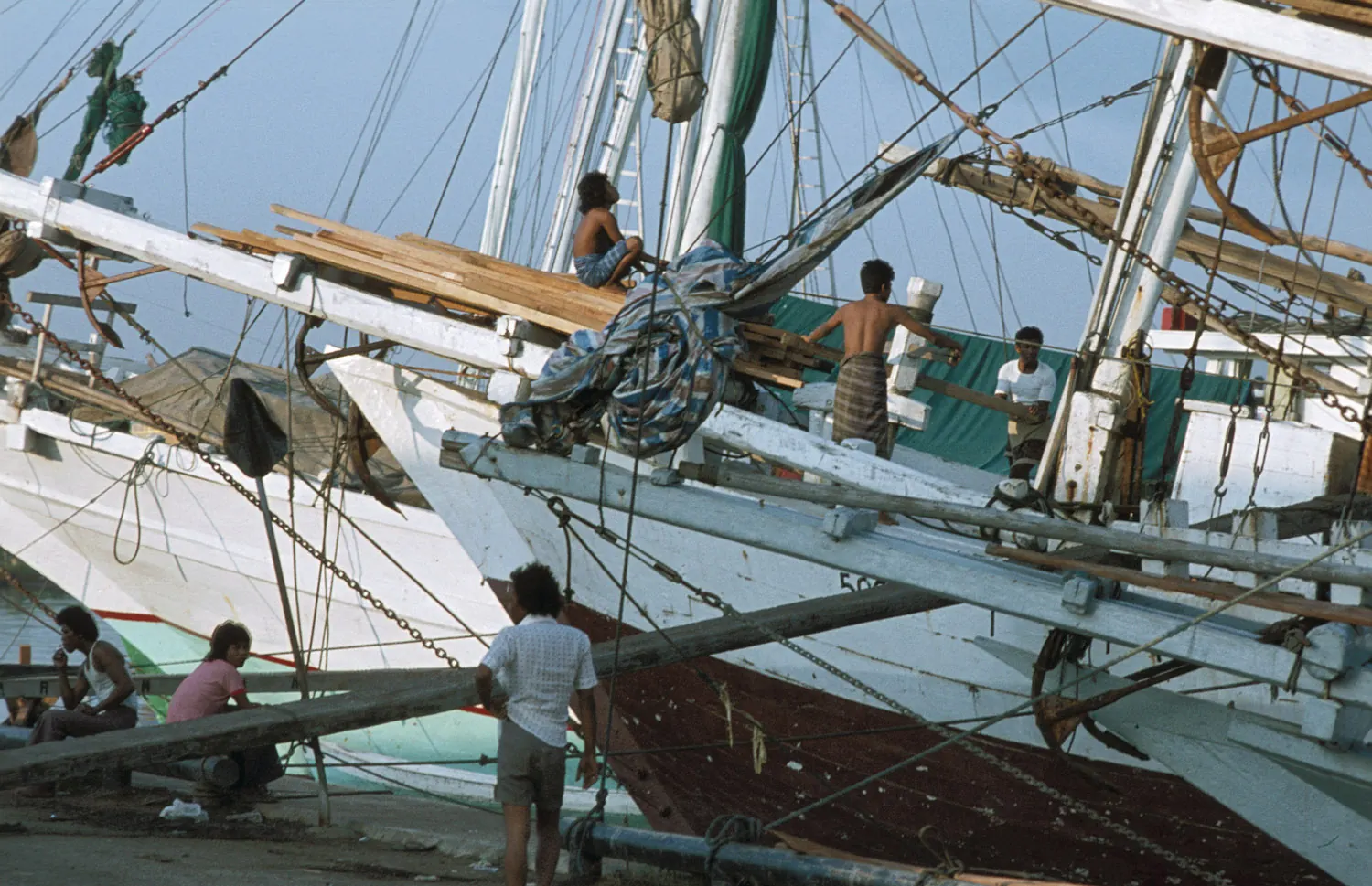
A pinisi carries seven or eight sails on two masts, according to both the English and Indonesian Wikipedia entries. The rig is arranged like a gaff-ketch, and its main sails are drawn out along fixed gaffs like curtains instead of being hoisted. The popular figure of seven is the low end of that range and not a fixed rule.
Why is the answer seven or eight, and not simply seven?
Because the reference sources give a range. Wikipedia's English entry describes the pinisi as a type of rigging with seven to eight sails on two masts, and the Indonesian entry says the same. Neither gives seven as the rule. "Seven sails" has become the popular version, and the correct response is to widen it by one.
The question also matters more here than it would for most boats. UNESCO describes "pinisi" as a word referring to the rig and sail of the Sulawesi schooner. On that definition, the sails are the feature that makes a vessel a pinisi, and the hull comes second. Wikipedia lists three general hull types that carry the rig: palari, lambo and jonggolang. Two boats with different hulls can both be pinisi, and that word says something about what stands above the deck. Our guide to the phinisi schooner follows the name further.
How are the sails arranged on the two masts?
Some of the arrangement is documented and some is not. Each of the following comes from Wikipedia's description:
- There are two masts.
- The main sails work on standing gaffs, meaning the spars stay aloft and the canvas is pulled out along them.
- A small triangular sail, the Tanpasere, sits at each mast.
- Additional sails are named by position, front and middle, with a further one for the row.
- A balancing triangle, the Anjong, sits on the foredeck.
What the description does not supply is a sail plan that itemises every sail, mast by mast, for the seven-sail and the eight-sail version. We would rather leave that open than draw one from assumption. Our page on the pinisi rig and sails sets out the wider arrangement.
What is each sail called?
Wikipedia records these Buginese names: sombala, the main sail; tanpasere, the small triangular sail at each mast; cocoro pantara and cocoro tangnga, additional sails at the front and middle; tarengke, a further additional sail; and anjong, the balancing triangle on the foredeck. Our page on the rig and sails sets them out in a table.
Counting the names will not give you the total. There are five sail names plus the Anjong, so the count depends on how many of each are carried and on whether the Anjong is counted. The Tanpasere alone shows why: one name, one per mast. Anyone who tells you exactly which sail makes the difference between seven and eight should be asked for a source.
What do standing gaffs change about how the rig looks and works?
On many gaff-rigged boats, the gaff is raised with the sail. On a pinisi it stays up, and the main sail is pulled out along it, which is the curtain comparison Wikipedia uses. Our reading of the practical effect is simple: with the sails stowed, the spars remain visible aloft, so a pinisi at anchor can still look rigged while setting no canvas at all. That is worth remembering when you look at a photograph of a boat and try to judge whether it sails. To go further into handling, read how a pinisi boat sails.
Why do charter brochures say seven?
We have no sourced account of where the shorter version began. Our guess is that a single round number is easier to print than a range, and that marketing copy tends to copy earlier marketing copy. The practical point stays the same whatever the origin. A brochure's seven does not contradict the sources, since seven lies within the range, but it does not tell you how many sails that particular boat carries either.
How many sails does a modern charter phinisi actually set?
That varies, and it is rarely documented boat by boat. Three facts explain why the name is a weak guide. The traditional trading fleet was motorised in the 1970s and 1980s, so an engine became the working drive for many of these vessels. Wikipedia also notes that "pinisi" is now used for most wooden ships in Indonesia, including charter and diving vessels marketed as "phinisi", so the label no longer implies the full rig. Published specifications may not settle it either. CharterWorld's report on Lamima, a 65.2-metre motor-sailer, gives North Sails at 1,277 square metres and does not count the sails.
If the sailing matters to you, put these questions to the operator before you book:
- How many sails does this boat carry, and which can be set at once?
- When did it last sail with the engine off, and for how long?
- Do the crew set the sails on a normal trip, or only for photographs?
- Which route and wind conditions make sailing realistic on your dates?
A straight answer such as "we motor, and raise two sails on a good day" is perfectly acceptable. It simply tells you that you are buying a motor cruise on a traditional-looking hull.
Where can you see the full rig?
No place on record promises it. Wikipedia names Sunda Kelapa in Jakarta and Paotere in Makassar as traditional ports frequented by pinisi vessels. Those are good places to see the boats. Since motorisation, a vessel in port or on the slip may show masts and spars with no canvas set, so a day at a harbour will not necessarily give you a complete count of seven or eight. Our page on where to see pinisi boats covers the options, and a charter that confirms sailing in writing is the more direct route to watching the rig at work.
FAQ: what are the short answers on pinisi sails?
Does a pinisi always have seven sails?
No. The reference entries give seven to eight sails on two masts. Seven is the popular figure, and the sail count on any one boat has to be checked on that boat.
What is the main sail of a pinisi called?
The main sail is the Sombala. It works on a standing gaff, so it is pulled out along the spar like a curtain instead of being hoisted with it.
Is the Anjong a sail?
The description we use calls it a balancing triangle on the foredeck and does not label it a sail. Whether it counts towards seven or eight is not settled by that description.
Is a pinisi a schooner or a ketch?
Both words appear in the sources. UNESCO refers to the Sulawesi schooner, while Wikipedia says the rig is arranged like a gaff-ketch. We report both and treat "pinisi" as the precise name for the rig.
Do all boats sold as phinisi carry the full rig?
No. The name does not promise a rig. Ask how many sails the boat carries and when they were last set.
Which sources support this page?
- Wikipedia: Pinisi
- Wikipedia (Indonesian): Pinisi
- UNESCO: Pinisi, art of boatbuilding in South Sulawesi
- CharterWorld: Lamima completion report
How do I reach the desk?
Have a question about a particular rig? Put it to the desk on WhatsApp at 6281139414563 or by email at bd@juaraholding.com.
Send the desk what you need: build, buy, or charter, plus rough size and timing.
Ask the desk on WhatsApp bd@juaraholding.com