On this page
- How do standing gaffs change the way the sails are set?
- What does each sail do on a pinisi?
- How did a pinisi sail before engines were fitted?
- What changed when engines arrived?
- How do pinisi navigate?
- How fast and how far can a pinisi sail?
- Has a pinisi made a long ocean voyage?
- What are the short answers on sailing a pinisi?
- Which sources support this page?
- How do I reach the desk?
By Pinisi Boat Editorial Desk
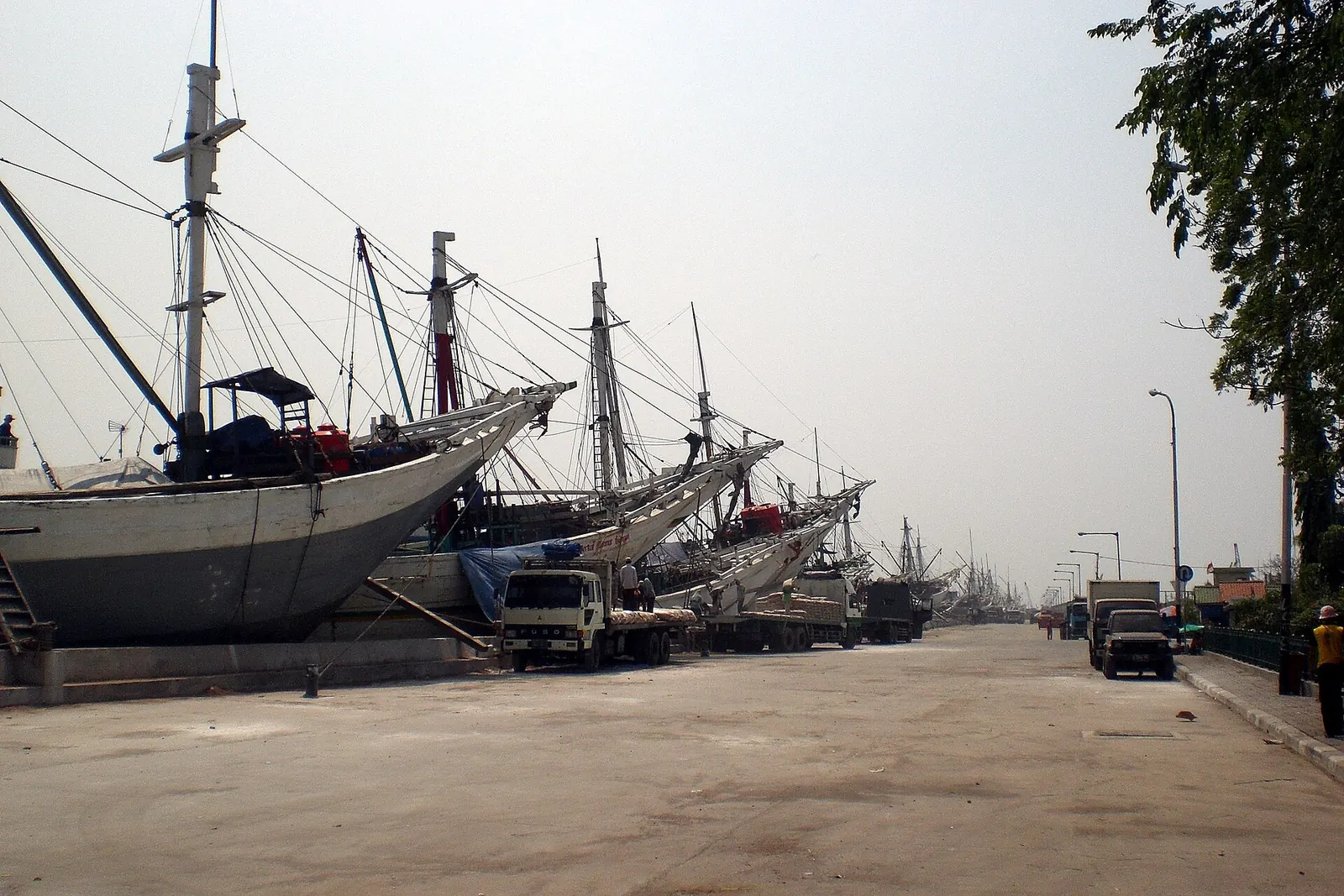
A pinisi sails on seven to eight sails set from two masts in a gaff-ketch arrangement, with the main sails drawn out along fixed gaffs like curtains rather than hoisted. Trading vessels have carried engines since the 1970s and 1980s, so a boat today may motor as well as sail. One naval architecture firm puts a 35 to 40 metre motorised cargo hull at perhaps 5 knots in mild conditions.
How do standing gaffs change the way the sails are set?
The word pinisi in pinisi boat describes a way of rigging a ship before it describes anything else. UNESCO says the term refers to the rig and sail of the Sulawesi schooner, and Wikipedia's Pinisi article gives the detail: seven to eight sails on two masts, arranged like a gaff-ketch, with what it calls standing gaffs. A gaff is the spar along a sail's top edge. On this rig the gaffs stay up, and the main sails are pulled out along them like curtains. They are not hoisted.
That one detail explains why a harbour photograph can show spars high on the masts with no sail set. The spar stays aloft while the cloth moves in and out along it.
The useful question for a captain is therefore how the cloth is drawn along the spar, in what order, and with how many hands. A crew that really uses its sails should be able to show you on deck, which is a good test in itself.
What does each sail do on a pinisi?
The sails have their own Buginese names, from the sombala, or main sail, to the small triangular tanpasere at each mast and the balancing anjong on the foredeck. The source says little about the role of each, and our page on the rig and sails has the full list.
Seven is the number you will hear most often, while the English and Indonesian Wikipedia articles both say seven to eight. Our short answer on how many sails a pinisi has deals with that difference.
How did a pinisi sail before engines were fitted?
On its sails, carrying freight. Wikipedia describes these ships as the largest Indonesian sailing vessels before the traditional trading fleet was motorised in the 1970s and 1980s. They carried inter-island cargo, timber from Kalimantan to Java being its example, and used traditional ports such as Sunda Kelapa in Jakarta and Paotere in Makassar.
The purely sailing era of the rig as a named type was fairly short. The first Sulawesi pinisi is thought to have been built in 1906, by shipbuilders of Ara and Lemo-Lemo for a skipper from Bira. That is a recent date inside a far older story: UNESCO places the pinisi within a millennia-long Austronesian tradition of boatbuilding and navigation.
So the answer to whether a pinisi can sail without an engine is yes, as history. Whether a particular boat you are looking at today can do so is a separate question, and the rest of this page is mostly about how to find out.
What changed when engines arrived?
Motorised vessels are called Perahu Layar Motor, or PLM, a name that keeps the word for sail. Average cargo capacity rose to about 300 tons, according to Wikipedia, and the lambo hull became the type favoured by motorised vessels. The same article records a pinisi-rigged PLM completed in Bulukumba in 2011 at 50 metres long and 9 metres wide, with a capacity of about 500 tons.
| Stage | Power | Example on record |
|---|---|---|
| Before motorisation | Sail | Largest Indonesian sailing ships, in inter-island cargo |
| From the 1970s and 1980s | Engine and rig (PLM) | Average cargo about 300 tons |
| 1986 | Motorised traditional vessel | Phinisi Nusantara, Indonesia to Vancouver |
| 2011 | Engine and rig (PLM) | 50 metre vessel, Bulukumba |
| 2014 to 2015 | Motor-sailer yacht | Lamima, 65.2 metres |
Yachts come last in that line. CharterWorld describes Lamima as a 65.2 metre motor-sailer with 1,277 square metres of North Sails. Meanwhile Wikipedia records the word spreading to charter and diving vessels. Between those two points, the name tells you very little about how much a given boat actually sails.
Some direct questions sort this out quickly. When were the sails last set, and on which passage? How many of them are aboard and in working order? Can the crew sail the boat with the engine off, and when did they last do it? Are the sails there to drive the vessel, or for photographs?
How do pinisi navigate?
For the traditional side, we can go only as far as UNESCO goes: the pinisi belongs to a long Austronesian navigation tradition. You will meet popular accounts of how the old skippers found their way, and we print none of those details as fact.
For a boat you may actually board, ask to see the equipment rather than hear about it. Which electronic navigation does the bridge use, and is there a backup if it fails? Are paper charts aboard for the route? Who keeps watch at night, and how do they call the captain? Those are our suggested questions rather than a statement of what the rules require. Our guide to checking a phinisi before you sail puts them alongside documents and safety gear.
How fast and how far can a pinisi sail?
The one figure we can cite is for motorised cargo vessels. Kasten Marine Design says a 35 to 40 metre KLM ordinarily carries an engine of around 200 horsepower, adequate for perhaps 5 knots in mild conditions, and describes motorised pinisi as generally under-powered and economical on fuel. We have found no published speed under sail alone for the type, and no range figure.
Distance on record comes from trade routes. AramcoWorld says long-distance pinisi followed the westerly winds for six months as far as Vietnam, Java and Sumatra, then came home on the easterlies. La Galigo Liveaboard, a charter operator, adds Malacca, Burma and Australia. A yacht with a modern engine and a large sail plan is a different case, so these figures do not transfer to it.
When a seller or brochure quotes a number, ask what stands behind it:
- Was the speed measured under sail, under engine or with both working?
- In what wind and sea state, and how heavily loaded was the boat?
- Does the range assume a fuel reserve, and at what engine setting?
- Can you see a log for a passage like yours, with date, distance, hours and engine time?
With a real log you can do the arithmetic yourself by dividing distance by time. That result, from that boat, is worth more than a figure for pinisi in general.
Has a pinisi made a long ocean voyage?
Yes, one voyage is on record. Phinisi Nusantara, which Wikipedia describes as a motorised traditional vessel, sailed from Indonesia to Expo 86 in Vancouver, Canada, in 1986. It also gave the world a spelling: the form "phinisi" was an attempt to mimic the Indonesian pronunciation and was first used for that ship.
Two cautions keep this in proportion. The vessel was motorised, so the voyage is no evidence of what the rig can do alone. And the source gives neither the route, nor the time taken, nor the share of the distance covered under sail. The working record of the type is inter-island trade, and we have no sourced account of an ocean crossing by a pinisi under sail alone.
What are the short answers on sailing a pinisi?
Can a pinisi sail without an engine?
Yes, historically. These were the largest Indonesian sailing ships before motorisation in the 1970s and 1980s. For a specific boat today, ask when the crew last sailed with the engine off.
How many masts and sails does a pinisi have?
Two masts and seven to eight sails, according to both the English and Indonesian Wikipedia articles, arranged like a gaff-ketch with standing gaffs.
What is a Perahu Layar Motor?
It is the motorised form of the pinisi-rigged trading vessel, known as PLM. Motorisation of the traditional fleet came in the 1970s and 1980s, and average cargo capacity rose to about 300 tons.
How fast does a pinisi sail?
We have found no figure under sail alone. Kasten Marine Design puts a motorised cargo hull of 35 to 40 metres at perhaps 5 knots in mild conditions. For a specific boat, ask for a passage log and divide distance by time, noting whether the engine was running.
Has a phinisi sailed to North America?
Yes. Phinisi Nusantara, a motorised traditional vessel, sailed from Indonesia to Expo 86 in Vancouver, Canada, in 1986.
Which sources support this page?
- UNESCO: Pinisi, art of boatbuilding in South Sulawesi (checked Oct 2026)
- Wikipedia: Pinisi
- Wikipedia (Indonesian): Pinisi
- CharterWorld: 65 m traditional phinisi yacht Lamima
- AramcoWorld: Pinisi Boats Sail into the Future (February 2021)
- Kasten Marine Design: The Indonesian Pinisi
- La Galigo Liveaboard: Phinisi boats, history and design
How do I reach the desk?
Know of a logged speed under sail with a source behind it? Tell the editorial desk on WhatsApp 6281139414563 or at bd@juaraholding.com.
Send the desk what you need: build, buy, or charter, plus rough size and timing.
Ask the desk on WhatsApp bd@juaraholding.com